

Country
Surface area
Segment


More project images


Used products






Befimmo ZEN Marketing Suite
At the ZEN building in Brussels’ Northern Quarter, Befimmo created a marketing suite designed to do more than present an office space. It invites visitors to experience the building’s potential.
Developed by the Befimmo Marketing and Communication team as part of the wider project of the ZEN building, the suite acts as a strategic tool for asset managers and prospective tenants. From spatial concept to interior design, every element was created to communicate flexibility, quality and sustainability.
Together with the modulyss Floor Design Service, the team developed a flooring concept that structures the open environment, guides movement and strengthens the overall atmosphere of the space.

A Space Designed to Project Possibility
For Befimmo, the goal was not simply to present a finished interior. The marketing suite had to help visitors imagine how the building could support different ways of working.
“The objective was to demonstrate the potential of the building through an environment that embodies Befimmo’s ambitions in terms of flexibility, quality and sustainability,” says François Martel, Visual and Marketing Specialist at Befimmo.
Instead of a traditional showroom, the team designed an immersive space where visitors can instantly project themselves into different scenarios, from collaboration and meetings to focused work and relaxation.
Another important element of the project was the reuse of existing furniture. Befimmo already had a stock of high-quality pieces, which made reuse both a responsible and logical choice.
“We had a stock of quality furniture. From a responsible perspective it made sense to prioritise integrating these elements rather than creating a completely new interior,” Martel explains.
Translating Architecture Into Flooring Design
The collaboration with modulyss started from a clearly defined layout. Functional zones, circulation routes and furniture placement were already mapped out.
From this framework, the modulyss Floor Design Service developed several flooring proposals to interpret the space. “We started with a moodboard to define a colour palette that would complement the architecture and existing interior elements,” explains Kiany De Busschere, Interior Concept Designer at modulyss. “From there, we mapped out the activities in the space and translated them into zoning through flooring.”
Three design concepts were created, each offering a different spatial interpretation while respecting the existing layout. “Flooring is not just a product decision,” says De Busschere. “It is a design tool that shapes how people move through and experience a space.”

Flooring as a Spatial Guide
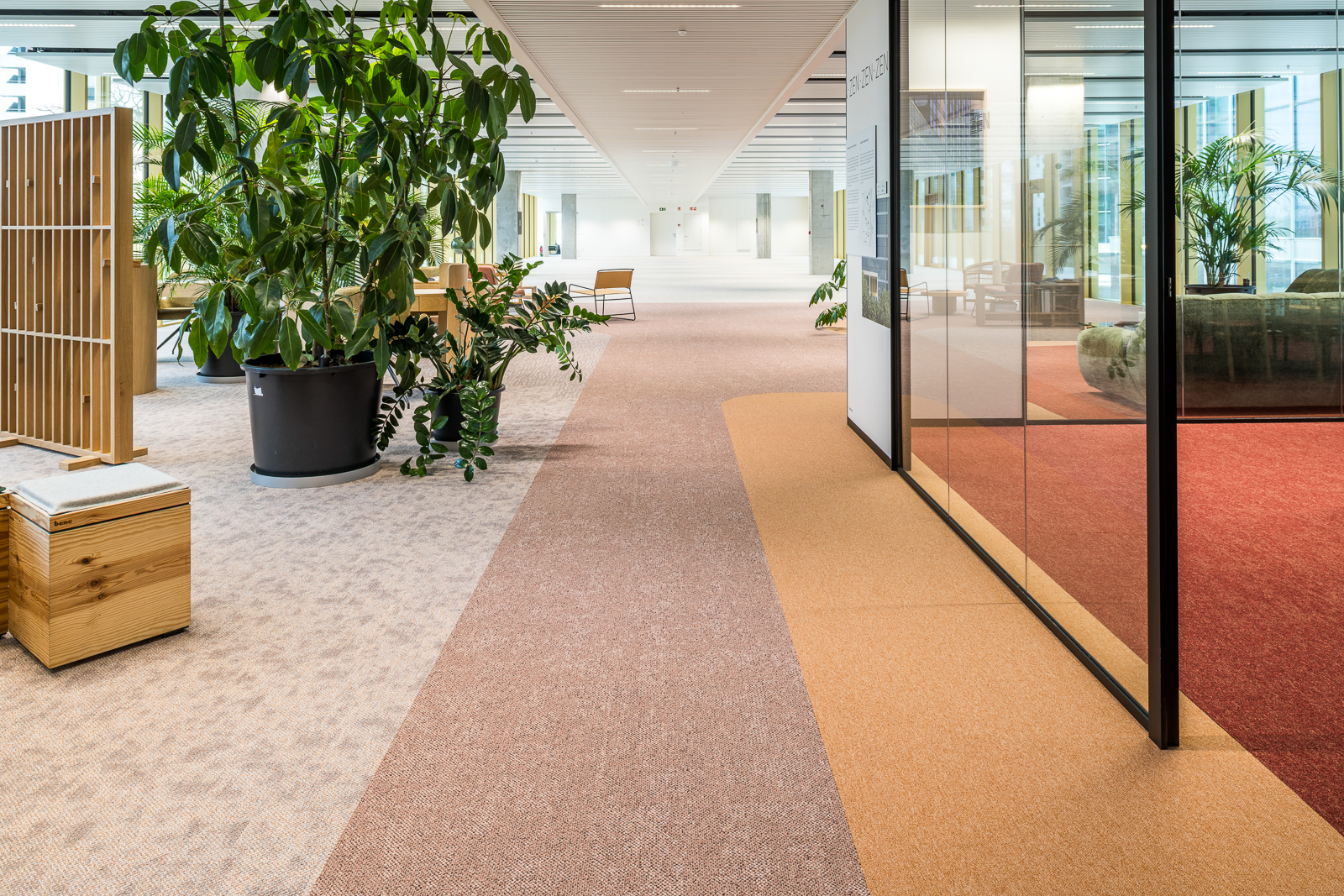
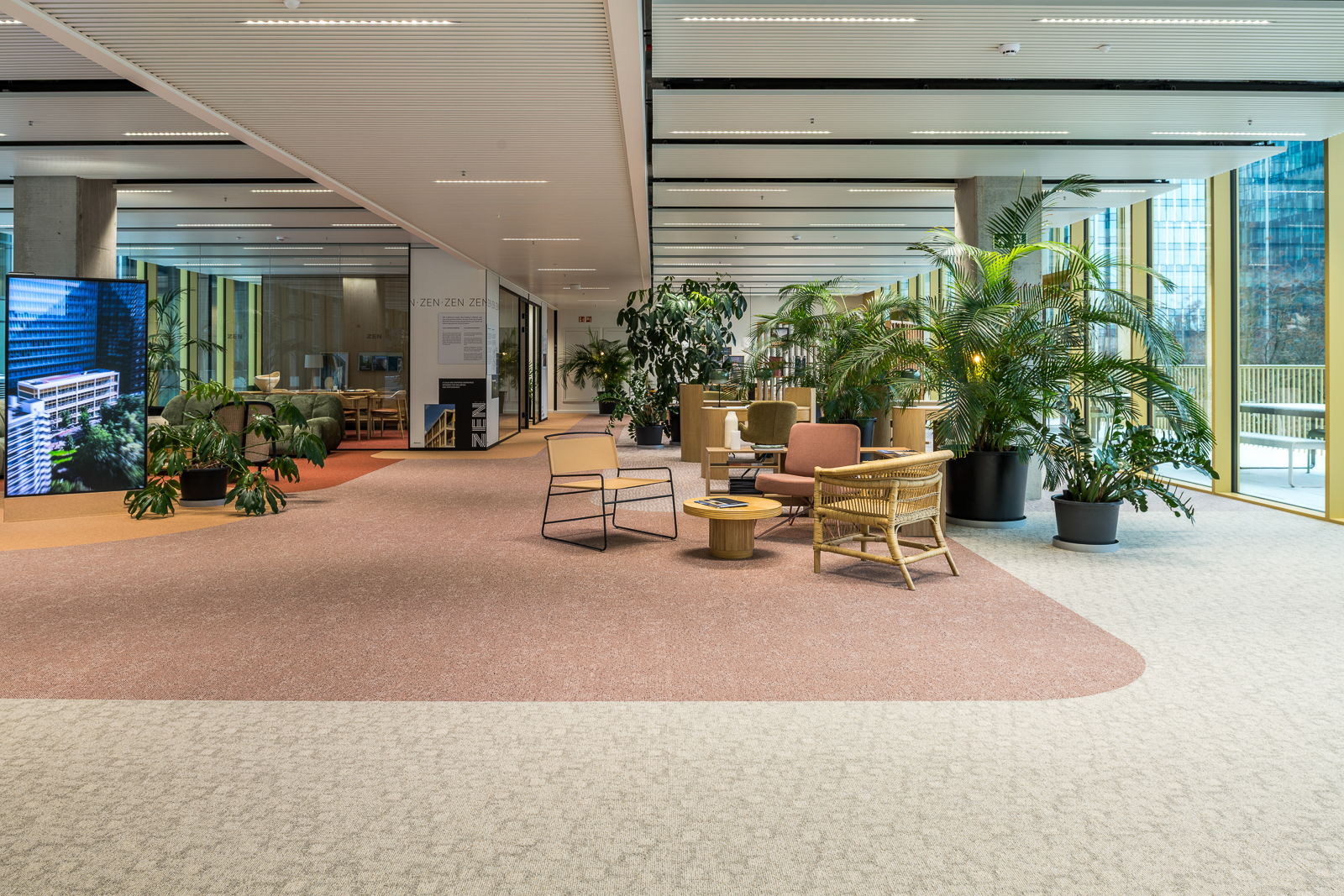
In an open environment, the floor becomes an important orientation tool. Instead of using physical partitions, the design relies on colour, texture and pattern to define different zones.
“Flooring is one of the most effective ways to create zones without closing spaces,” says De Busschere. “You create invisible boundaries while keeping the environment open.”
A bright orange pathway forms the central element of the floorplan. Starting at the entrance, it guides visitors through the space towards the meeting rooms and lounge area. “From the moment you enter, the walkway leads you through the different areas of the showroom,” De Busschere explains.
For Befimmo, this strategy improved the space's clarity: “The floor designed by modulyss structures the uses without physical partitions,” says Martel. “Collaborative zones, circulation areas and focus spaces become intuitive to understand.”
Materials and Collections Working Together
The project demonstrates how multiple flooring collections can work together to create a balanced yet dynamic interior.
The floorplan combines several modulyss collections, including Monos, Trace, Rust, Lume, Ray, Moss, Ivy and the LVT collection Urban.
In the lounge area, Moss introduces texture and comfort. For the focused workspaces, Ray and Lume add subtle variation through pattern while maintaining a consistent colour palette. In high-traffic areas such as the coffee corner, the LVT collection, Urban, was selected for its durability and easy maintenance.
“Design always balances aesthetics and practicality,” says De Busschere. “You look at acoustics, durability and maintenance while keeping the concept intact.”

Comfort and Wellbeing
Comfort was an important priority throughout the project. In office environments, acoustic and sensory comfort directly influence wellbeing and concentration.
“In a workspace, comfort is essential,” Martel explains. “Acoustic quality and sensory perception influence how people feel and work in the environment.”
Carpet tiles contribute significantly to acoustic absorption while also creating a warmer atmosphere compared to harder surfaces. “The choice of carpet helped avoid a space that feels too cold or institutional,” Martel adds.
The floor also contributes to the visual balance of the interior. Subtle variations in texture and tone prevent monotony and create a calm, coherent environment.
Designing with Sustainability in Mind
Sustainability played a key role in the project. The reuse of existing furniture significantly reduced the need for new materials.
For the flooring, the selected collections incorporate recycled materials, low-carbon nylon and eco-designed backing solutions such as ecoBACK PLUS. Several carpet collections are also Cradle to Cradle Certified® Silver version 4.0.
The modular nature of carpet tiles also supports long-term flexibility. “Modularity allows spaces to evolve without major intervention,” Martel explains. “Tiles can be replaced locally when needed, extending the lifespan of the interior.”

A Subtle Yet Defining Design Element
Today, the flooring quietly anchors the atmosphere of the ZEN building’s marketing suite. Visitors often comment on the comfort and coherence of the space, even if the floor itself is not always mentioned directly. “That is often the sign that the design works,” Martel reflects. “The floor supports the project without imposing itself visually.”
For De Busschere, this is precisely the strength of floor design. “The floor connects everything,” she says. “It structures the space, guides movement and strengthens the experience of the environment.”